
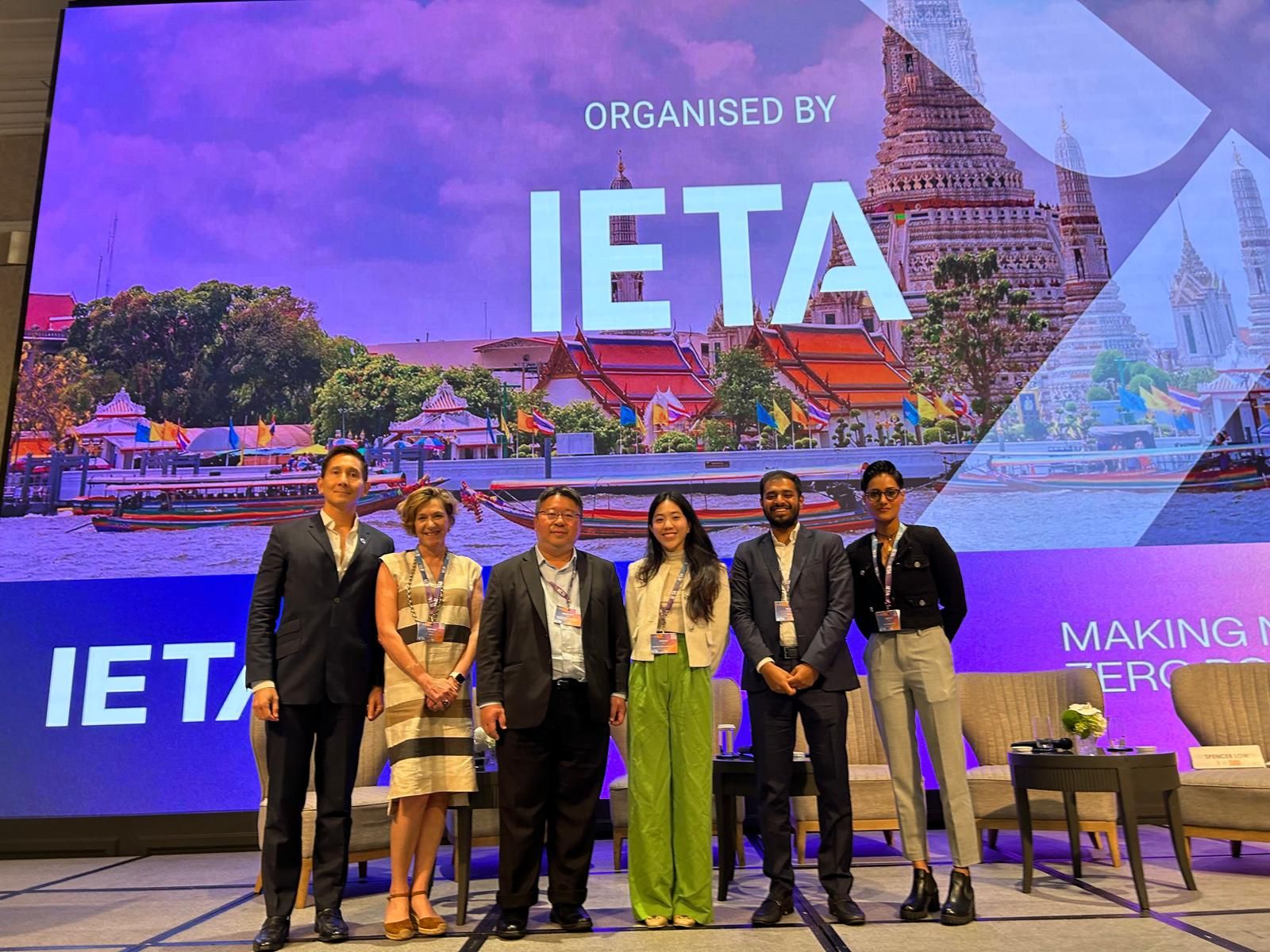
Bangkok, Thailand – 10th July, 2025 – The Asia Climate Summit 2025’s third day featured a dynamic panel discussion on “The Voluntary Carbon Market – Challenges, Choices and the Way Forward.” Moderated by Andrea Abrahams, VCM Managing Director at IETA, the discussion brought together leading voices from government, industry, and the private sector to explore the evolving landscape of carbon offsetting. Panelists included:
The conversation highlighted key initiatives like the Asia Common Carbon Framework (ACCF), Voluntary Carbon Markets Integrity Initiative (VCMI), The Integrity Council for the Voluntary Carbon Market (ICVCM), and the crucial role of ISO, The International Emissions Trading Association (IETA) and The Science Based Target Initiative (SBTi) guidelines in ensuring the credible use of carbon offsets and preventing greenwashing. A central theme was the collective move towards establishing clear guidelines and fostering collaboration within the ASEAN region.
Building a High-Integrity, Interconnected Market
A significant focus of the discussion revolved around the efforts to create a more interconnected and interoperable carbon market, particularly within Asia. The ACCF, an initiative primarily shaped by companies, aims to unify diverse national rules and regulations, thereby enhancing market efficiency and accelerating learning across the region. Panelists emphasized the importance of high-integrity markets that adhere to globally recognized standards. This includes clarifying rules related to specific project types and aligning efforts to create a more unified ecosystem for market participants. The ACCF’s development is seen as a pivotal step towards building confidence and signaling to governments the importance of supporting credible carbon markets.
Bridging Voluntary and Compliance Markets
The evolving relationship between voluntary carbon markets (VCMs) and compliance markets was another key area of discussion. While historically distinct, the increasing sophistication of mechanisms like Article 6.4 of the Paris Agreement and the growing interest from sectors such as aviation are blurring these lines. The ACCF is actively working to develop stronger linkages, suggesting a future where VCMs may play an increasingly integrated role within compliance regimes, moving beyond the traditional separation. Governments play a vital role in this evolution by introducing key guidelines that instill confidence among corporations.
International Collaboration and Regional Initiatives
International cooperation is crucial in developing a cohesive carbon market. The UK Foreign, Commonwealth and Development Office (UKFCDO), through its involvement with ASEAN, underscored its commitment to supporting the development of a regional cohesive carbon market. This support includes funding for governance structures and work plans, with an emphasis on identifying commonalities rather than differences among countries. The shared ambition for scaling high-integrity supply, driving demand, and building robust market infrastructure is seen as a unifying force in ASEAN’s journey towards carbon neutrality. Initiatives like mutual recognition for standards, resource availability for human capital, and creating neutral platforms for industry feedback are central to this collaborative effort.
The UK Government’s “Principles for Voluntary Carbon & Nature Market Integrity” were also highlighted as a framework for responsible carbon credit usage. These principles advocate for:
* Using credits as a complement to ambitious decarbonization actions within value chains.
* Utilizing high-integrity credits.
* Measuring and disclosing credit usage in sustainability reporting.
* Proactive long-term planning for credit use.
* Making accurate green claims with appropriate terminology.
* Cooperating with others to foster market growth.
Such collaborations, including Symbiosis (a coalition of companies founded by Google, Microsoft, Meta, Salesforce and McKinsey & Company) underscore the need for certainty and clarity for industries operating across multiple jurisdictions.
From a carbon credit buyer’s perspective, corporations face significant challenges. The growth in AI and data centers presents a surging energy demand, with considerable uncertainty surrounding the future direction of energy consumption. The limited availability of scalable, firm, and dispatchable clean power, especially in the Asia Pacific region, adds to these complexities. Despite these hurdles, major corporations are maintaining ambitious climate commitments, aiming for net-zero emissions by aggressively reducing operational emissions and neutralizing residual emissions through carbon-renewable solutions.
It was strongly emphasized that decarbonizing operations must be the primary focus for corporations before considering carbon credits. Coalitions like Frontier and Symbiosis are vital for pooling demand, magnifying impact, and sharing learnings to accelerate the development of carbon removal technologies.
Regarding best practices for carbon offsets, a focus on removals was highlighted due to ongoing debates around avoidance credits. Key principles for carbon credit procurement include certainty and scale, with a deep understanding of the underlying science and evolving technologies. While Renewable Energy Certificates (RECs) are not formal carbon credits, their use is considered appropriate when bundled with investments that bring additional new carbon-free energy into systems.
Mitigating Risks and Building Market Confidence
The discussion also touched upon the critical role of risk mitigation in the voluntary carbon market. Carbon insurance emerged as a key mechanism, particularly for de-risking projects at their earliest stages, even before a tree is planted. Insurance aims to ensure that funders (e.g., pre-purchasers or banks) receive their promised credits or get their money back if projects fail to deliver. Insurable risks are those that can be quantified and priced based on historical data and financial models.
However, new technology risk, where historical data is lacking, remains largely uninsurable. This is where coalitions and pilot projects play a crucial role by proving concepts and de-risking new technologies, paving the way for traditional institutional finance and insurance to enter later.
The market is seeing a growing maturity and interoperability between different frameworks and standards. This involves developing a common language and understanding across the ecosystem, with standard setters like ICVCM (Core Carbon Principles) and VCMI (Code of Claims) working in alignment to enhance integrity and transparency from supply to demand. Initiatives such as the International Carbon Reduction and Offset Alliance (ICROA), which endorses crediting programs and approves service providers, are crucial in bridging the gap between corporate commitments and market participation by mitigating risk.
The panel concluded that a collaborative approach, clear governmental guidelines, and continuous innovation in market mechanisms are essential to unlock the full potential of the voluntary carbon market in driving climate action across Asia and beyond.

Schedule a Free Consultation with a Climate Strategist Today


Stay ahead of the curve
Copyright © 2025 Designed By Asia Media Studio, All rights reserved.


